Lead Prototype

To meet the challenge of installing functional prototypes for Blackwood, it was decided to use the Dundee houses as part of the pre-production development process.
The houses would be provided with beta-phase prototypes, to provide the residents with transformative technology, and help recover time lost through illness.
This also allowed us to catch any final edge cases that were outside of the original scope.
Given the personal and financial investments involved, strenuous efforts were made to complete the prototypes, in a challenging environment where failure is always a possibility.
Technology
Many innovative technical solutions were developed for the beta model in the lead up to the Blackwood opening.
For the fully accessible door, a combined inflatable waterproof seal and interlock was successfully tested and integrated. As the machine is operated remotely via Bluetooth, internal safety switches were incorporated into the cabinet body.
Multiple integral soap dispensers allowed for a variety of cleansing agents (anti-microbial and stain removers) to be deployed through cycle selection, dependent on user needs.
A combined revised condensing panel and protective divider was designed, to increase the drying effectiveness.
Tritec created an Android app, and designed, built, and integrated the additional electronics to allow for Bluetooth operation.


Construction
E3design finalised the layout and individual components that comprised the inner and outer cabinets.
A set of machined parts for the Lead Prototype was manufactured and assembled in jigs and rigs we designed and built.


Your support and funding will allow us to:
Hire designers and Engineers so they can bring their knowledge and expertise to help develop the next stage of this project.
To purchase and commission 3D printers to make the washing machine, so we aren’t dependent on expensive parts from custom manufacturers and reduce development time and costs.
Testing
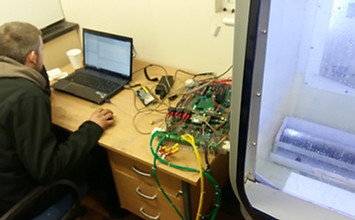
The second prototype was repurposed into a hardware-in-the-loop testbench, fitted with an identical interface to the Lead Prototype.
This allowed functionality to be tested and monitored on the workbench, prior to embodiment within the limited real estate of the finished model.

Compliance
The Procurement process ensured the components met the necessary regulatory requirements for deployment in a domestic appliance.
Regulatory compliance approval was essential. Tritec were the designated Design Authority for the electrical hardware, as Brompton Washscape did not have compliance sign-off capability.
Exterior Design
E3design finalised the layout and individual components that comprised the inner and outer cabinets. The colours were carefully chosen, to emphasise and accentuate the form and finish.
It looked, and still looks, like no other washing machine.
A set of machined parts for the Lead Prototype was manufactured and assembled in jigs and rigs. The colours were carefully chosen, to emphasise and accentuate the form and finish.
It looked, and still looks, like no other washing machine.


How your pledge could impact our research
Without funding or investment, we can’t deliver this revolutionary product, which has the potential to transform the lives of wheelchair and limited mobility users around the world.
IPR
The Fold-Out Hanger was granted a UK Patent during this period.
Media from the Blackwood Scrutiny Groups were submitted, to support the Plurality Hanger IPR application; the Examiner found them very helpful.


Safety issues
The pre-production machines were machined and bonded, rather than using production-scale injection moulding. The components were to be fabricated utilising pre-booked manufacturing capacity, in an allocated time slot. This meant the design freeze was immovable.
In hindsight, the development timescales were over-ambitious, which limited testing of crucial parts and gave no opportunity for Blackwood user feedback.
During testing with the inflatable seal, we identified that there was a flaw in the door handle, which ultimately failed.
Without further budget, we were unable to redesign and test this safety-critical item, and Blackwood were moving their residents into the houses. It was an unsatisfactory way for the Project to end, even if it did look fantastic.


